PSI and GPM Explained: Why Buying on PSI Alone Is a Mistake
Two numbers on every spec sheet, and most buyers only ever look at one of them.
September 10, 2026 · 3 min read
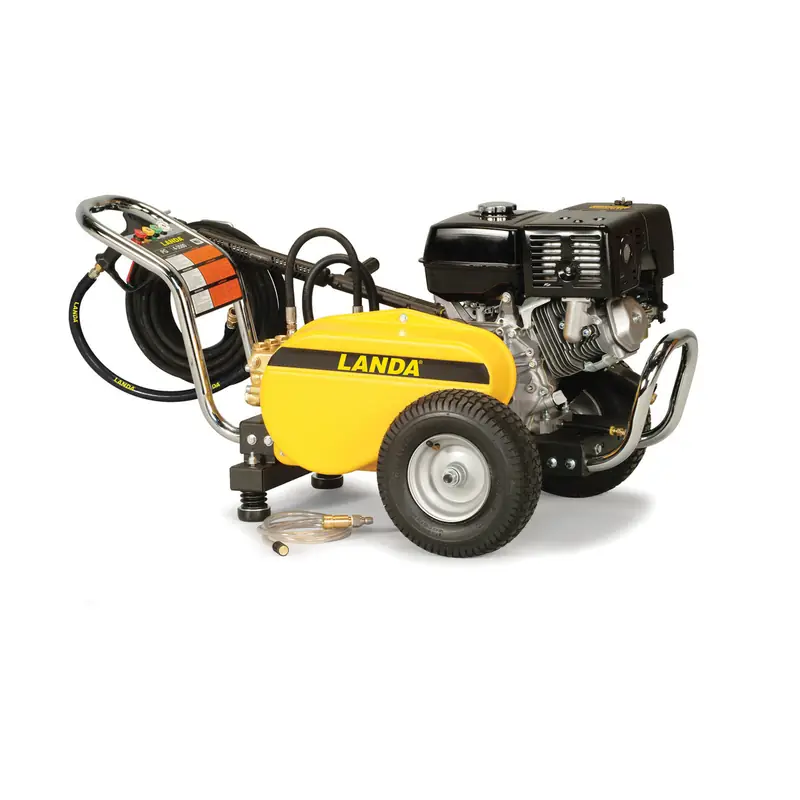
Every pressure washer has two numbers stamped on the spec sheet: PSI and GPM. Most people who walk in the door can tell us the PSI they want. Almost nobody asks about the GPM. That's backwards, and it's the reason a lot of buyers end up disappointed with a machine that's technically more powerful than what they had before.
PSI is force. GPM is what moves the dirt.
PSI, pounds per square inch, measures how hard the water hits the surface. It's what breaks the bond between dirt and whatever it's stuck to. GPM, gallons per minute, is the flow rate, and flow rate is what actually carries the loosened dirt off the surface and away. A machine can hit a surface hard and still leave you standing there for twice as long if the flow rate behind that pressure is too low to rinse the mess away as fast as it's broken loose.
Think of it as breaking the dirt free versus clearing it off. High PSI with low GPM breaks dirt free slowly and clears it off slowly. A machine with strong GPM alongside solid PSI covers ground faster, because it flushes the spot clean and moves on instead of sitting there blasting away at it.
Why PSI-only shopping backfires
A lot of buyers compare machines on PSI the way they'd compare cars on horsepower, and manufacturers know it, so PSI is the number that gets printed biggest on the box. Two machines can carry the same PSI rating and clean at genuinely different speeds because their GPM isn't the same. If you're cleaning a parking lot, a fleet yard, or anything with real square footage, low GPM turns into hours of extra work no matter how high the PSI reads.
What actually fits your work
- Light residential jobs, siding, decks, driveways, patios: 1,500 to 2,000 PSI is enough, paired with a GPM that suits the surface area you're covering
- Heavy commercial work, fleet washing, contractor equipment, large paved surfaces: 3,000 to 4,000+ PSI, and GPM matters just as much here because of the ground you need to cover
Those ranges are the honest starting point for most jobs we see, residential on the low end and heavy commercial on the high end. Where you land inside that range, and what GPM you pair it with, depends on the surface, how much of it there is, and what's actually stuck to it.
The nozzle changes the equation too
PSI and GPM off the pump are only half the story once you put a nozzle or attachment on the wand. A turbo nozzle or a rotary nozzle concentrates that same flow into a tighter, more aggressive pattern, which is why two operators running the same machine can get noticeably different results depending on what's screwed onto the end of it. Surface cleaners spread the water over a wider path for flat concrete and paved areas, trading some of that concentrated force for coverage speed. None of that shows up on the machine's spec sheet, but it changes how the PSI and GPM you bought actually behave on the job.
Ask about both numbers, not just one
When you're comparing machines, whether that's new equipment, used inventory, or something you're renting for a single job, ask about GPM in the same breath as PSI. A machine with a slightly lower PSI and a stronger GPM will often outperform a higher-PSI unit on real-world jobs with any amount of square footage to cover. That's not marketing, it's just how water pressure and volume actually work together.
Hose length and hose diameter matter here too, though they get even less attention than GPM does. A longer hose or a narrower one adds friction loss between the pump and the nozzle, which quietly eats into the pressure and flow you're paying for by the time the water actually leaves the wand. It's rarely the deciding factor in which machine to buy, but it's worth mentioning when you're setting up a rig for a trailer or a job site where the hose run is going to be long.
If you're not sure what combination fits your job, tell us what you're cleaning and how much of it there is, and we'll match you with the right numbers instead of just the biggest ones. Come and see the current units on the showroom floor, or call the counter at (248) 615-4400 and we'll talk it through.
Atomic Cleaning Systems, (248) 615-4400
Call (248) 615-4400More articles
Hot Water or Cold Water: Picking the Right Pressure Washer for the Job
The question we get asked more than any other, answered honestly instead of sold.
Rent or Buy: An Honest Way to Decide on Pressure Washing Equipment
The question isn't which is cheaper up front. It's how often the machine is actually going to run.